Thursday, July 3, 2008
Celebrate this summer's Olympic Games in Beijing, China, with our resources, activities, and lessons. You'll find resources on China's history and culture, which will help your students better understand the country and its traditions. Discussing the politics of China, and the Olympic Games in general, will also be enlightening: learn why there is controversy surrounding the 2008 Games. Plus, we have resources on the past political issues of the Olympics, information about gold medalists, and lessons incorporating the fun of the Olympic sporting events.

Friday, June 27, 2008
The Beijing 2008 Olympics

Beijing will host the 2008 Olympics, mostly in a newly developed Olympics Park in the north of the city - in fact, on the ancient north-south axis that includes the Forbidden City. The opening ceremony will be held at 8pm on 08/08/08. Eight is a lucky number in chinese culture.

A model of the Olympic Green.
Beijing China won the hosting of the 2008 Olympics by a landslide vote in 2001, with 56 votes to nearest placed Toronto Canada with 22 (the winter Olympics of 2010 will be held in Vancouver Canada).

A large Olympics poster in a Beijing subway station.
The coming 2008 Beijing Olympics have generated a lot of excitement. Sports stars beam out from many posters around the city and taxi drivers are making an effort to learn english through tapes and radio.


Beach volleyball, sailing, and open water swimming events will be held in QingDao, a coastal city to the south east of Beijing. Equestrian events will be held in Hong Kong. Football preliminaries will also held in the cities of ShangHai, TianJin and QinHuangDao.

The chinese Olympics teams have been getting nearer and nearer to coming first overall, and this could well be the year when China comes out on top for the first time.

The 'Bird's Nest, National Olympic Stadium.
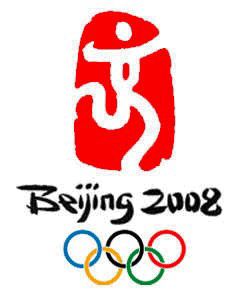
The 2008 Beijing Olympics emblem, entitled 'Dancing Beijing', combines elements of traditional Chinese culture - a red seal and the calligraphic word for 'jing' ('national capital') with athletic features.
The Friendlies (mascots) were unveiled on November 11, 2005 at an event marking the 1000th day before the opening of the Beijing Olympics.

The Friendlies consists of five members: BeiBei, JingJing, HuanHuan, YingYing, and NiNi. The five mascots incorporate fish, giant panda, fire, Tibetan antelope, and swallow designs respectively, and each also represents one of the five Olympic Rings. When the five names are put together, they form a pun on the phrase 'Beijing HuanYing Ni' which means 'Beijing Welcomes You'.

The current plan for the Olympics torch relay is through the sites of ancient civilisations - Greece, Italy, Egypt, Iraq, Iran, India and China. The 2008 Beijing Olympics torch relay will achieve a world record as eighty specially trained mountaineers carry the Olympic flame to the top of Mount Everest (known to the Tibetans as Chomolangma), making it the highest altitude achieved in the history of Olympic torch relays. It will be carried up the southern slope from Nepal before carried down the northern slope into the Tibet Autonomous Region. The Olympic torch will pass through 78 cities in China on its way to Beijing.


Beijing Paralympic coins to go on sale

The obverse of the 1/3-ounce gold coin to commemorate the Beijing Paralympic Games

The reverse of the one-once silver coin to commemorate the Beijing Paralympic Games
(BEIJING, June 23) -- The People's Bank of China has announced that it will issue a set of two coins, one gold and the other silver, to commemorate the Beijing 2008 Paralympic Games on Monday, June 23.

The reverse of the 1/3-once gold coin to commemorate the Beijing Paralympic Games
The obverse of both coins features the Paralympic emblem, the name of the host country, and the calendar year of issue. The reverse of the 1/3-once gold coin shows the pictograms of the 20 sports for the 2008 Paralympics and the face value of 150 yuan. The maximum circulation for the gold coin is 15,000 pieces, the bank said in its Public Notice No. 10.

The obverse of the one-once silver coin to commemorate the Beijing Paralympic Games
Fu Niu Lele, the mascot for the Paralympics, is featured on the reverse of the one-once silver coin, which has a face value of 10 yuan. Its circulation is limited to 30,000.
The China Gold Coin Incorporation will distribute the coins through its direct selling centers, branches and licensed retail distributors. Collectors are advised to find information on Chinagoldcoin.net.
The Official Mascots of the Beijing 2008 Olympic Games
The 2008 Beijing Olympics will be an historic event as China hosts one of the great sporting events of the century. We are proud of the great advancements that have been made in China to allow such an event to happen. We would like you to help us celebrate.
This website is dedicated to providing good information that will assist you to learn more about the Beijing 2008 Olympics and China as a whole.


Like the Five Olympic Rings from which they draw their color and inspiration, Fuwa will serve as the Official Mascots of Beijing 2008 Olympic Games, carrying a message of friendship and peace -- and good wishes from China -- to children all over the world.
Designed to express the playful qualities of five little children who form an intimate circle of friends, Fuwa also embody the natural characteristics of four of China's most popular animals -- the Fish, the Panda, the Tibetan Antelope, the Swallow -- and the Olympic Flame.
Each of Fuwa has a rhyming two-syllable name -- a traditional way of expressing affection for children in China. Beibei is the Fish, Jingjing is the Panda, Huanhuan is the Olympic Flame, Yingying is the Tibetan Antelope and Nini is the Swallow.
When you put their names together -- Bei Jing Huan Ying Ni -- they say "Welcome to Beijing," offering a warm invitation that reflects the mission of Fuwa as young ambassadors for the Olympic Games.
Fuwa also embody both the landscape and the dreams and aspirations of people from every part of the vast country of China. In their origins and their headpieces, you can see the five elements of nature -- the sea, forest, fire, earth and sky -- all stylistically rendered in ways that represent the deep traditional influences of Chinese folk art and ornamentation.
Spreading Traditional Chinese Good Wishes Wherever They Go
In the ancient culture of China, there is a grand tradition of spreading good wishes through signs and symbols. Each of Fuwa symbolizes a different blessing -- and will honor this tradition by carrying their good wishes to the children of the world. Prosperity, happiness, passion, health and good luck will be spread to every continent as Fuwa carry their invitation to Beijing 2008 to every part of the globe.
At the heart of their mission -- and through all of their work -- Fuwa will seek to unite the world in peace and friendship through the Olympic spirit. Dedicated to helping Beijing 2008 spread its theme of One World, One Dream to every continent, Fuwa reflect the deep desire of the Chinese people to reach out to the world in friendship through the Games -- and to invite every man, woman and child to take part in the great celebration of human solidarity that China will host in the light of the flame in 2008.

In China's traditional culture and art, the fish and water designs are symbols of prosperity and harvest. And so Beibei carries the blessing of prosperity. A fish is also a symbol of surplus in Chinese culture, another measure of a good year and a good life.
The ornamental lines of the water-wave designs are taken from well-known Chinese paintings of the past. Among Fuwa, Beibei is known to be gentle and pure. Strong in water sports, she reflects the blue Olympic ring.

Jingjing makes children smile -- and that's why he brings the blessing of happiness wherever he goes. You can see his joy in the charming naivety of his dancing pose and the lovely wave of his black and white fur. As a national treasure and a protected species, pandas are adored by people everywhere. The lotus designs in Jingjing's headdress, which are inspired by the porcelain paintings of the Song Dynasty (A.D.960-1234), symbolize the lush forest and the harmonious relationship between man and nature. Jingjing was chosen to represent our desire to protect nature's gifts -- and to preserve the beauty of nature for all generations. Jingjing is charmingly naïve and optimistic. He is an athlete noted for strength who represents the black Olympic ring.

In the intimate circle of Fuwa, Huanhuan is the big brother. He is a child of fire, symbolizing the Olympic Flame and the passion of sport -- and passion is the blessing he bestows. Huanhuan stands in the center of Fuwa as the core embodiment of the Olympic spirit. And while he inspires all with the passion to run faster, jump higher and be stronger, he is also open and inviting. Wherever the light of Huanhuan shines, the inviting warmth of Beijing 2008 -- and the wishful blessings of the Chinese people -- can be felt. The fiery designs of his head ornament are drawn from the famed Dunhuang murals -- with just a touch of China's traditional lucky designs. Huanhuan is outgoing and enthusiastic. He excels at all the ball games and represents the red Olympic ring.

Like all antelopes, Yingying is fast and agile and can swiftly cover great stretches of land as he races across the earth. A symbol of the vastness of China's landscape, the antelope carries the blessing of health, the strength of body that comes from harmony with nature. Yingying's flying pose captures the essence of a species unique to the Qinghai-Tibet Plateau, one of the first animals put under protection in China. The selection of the Tibetan Antelope reflects Beijing's commitment to a Green Olympics. His head ornament incorporates several decorative styles from the Qinghai-Tibet and Sinkiang cultures and the ethnic design traditions of Western China. Strong in track and field events, Yingying is a quick-witted and agile boy who represents the yellow Olympic ring.

Every spring and summer, the children of Beijing have flown beautiful kites on the currents of wind that blow through the capital. Among the kite designs, the golden-winged swallow is traditionally one of the most popular. Nini's figure is drawn from this grand tradition of flying designs. Her golden wings symbolize the infinite sky and spread good-luck as a blessing wherever she flies. Swallow is also pronounced "yan" in Chinese, and Yanjing is what Beijing was called as an ancient capital city. Among Fuwa, Nini is as innocent and joyful as a swallow. She is strong in gymnastics and represents the green Olympic ring.
Thursday, June 26, 2008


LOCALLY OWNED BY PAMPLIN MEDIA GROUP
If the favorites survive the trials, American athletes could head to Beijing for the August Games confident of sweeping Olympic medals in both the men's …
If the favorites survive the trials, American athletes could head to Beijing for the August Games confident of sweeping Olympic medals in both the men's …
Subscribe to:
Posts (Atom)